Salesforce Unveils Koa and AIforce to Redefine CRM Intelligence and Challenge General-Purpose AI Models

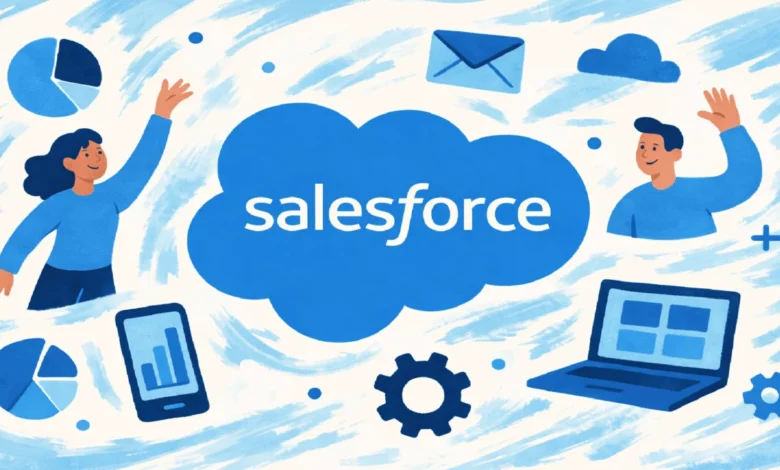
Salesforce has officially entered a new phase of enterprise artificial intelligence competition with the introduction of Koa, its first specialized Customer Relationship Management (CRM) reasoning model, alongside a broader interoperability framework known as AIforce. Unveiled at the company’s flagship Dreamforce conference, Koa was developed in collaboration with chipmaker Nvidia to navigate complex, multi-step sales, service, and marketing workflows. By anchoring the model in decades of enterprise business logic rather than raw internet text, Salesforce aims to establish a formidable defensive moat against general-purpose foundational models offered by competitors such as OpenAI, Anthropic, and Google.
The announcement comes at a transformative time for the enterprise software sector, where generative AI has rapidly shifted from a novelty tool for drafting text and images to an operational engine capable of driving automated business processes. While general-purpose LLMs (Large Language Models) excel at summarization and creative generation, they frequently struggle with the granular, rules-based realities of corporate operations. Salesforce’s strategy recognizes that modern enterprises require more than conversational assistants; they require autonomous agents that understand corporate hierarchies, customer lifecycles, and industry-specific compliance frameworks.
Chronology and Development of Koa
The development of Koa represents a significant milestone in Salesforce’s multi-year artificial intelligence roadmap, which began in earnest with the rollout of Einstein AI and evolved into the agent-focused ecosystem known as Agentforce. Built upon Nvidia’s Nemotron 3 Super architecture, Koa was meticulously post-trained using a proprietary synthetic dataset. This dataset was constructed from the ground up to reflect decades of accumulated enterprise deployment experience across more than 14 distinct industries.
Crucially, Salesforce has emphasized that no customer data was utilized during the training phase of Koa, addressing persistent corporate anxieties regarding data privacy and intellectual property leakage. To maintain absolute security, Salesforce controls the model weights and executes all inference operations strictly within its own proprietary infrastructure. This ensures that sensitive customer information never crosses external trust boundaries—a critical requirement when an AI agent transitions from drafting marketing copy to executing high-stakes tasks like updating customer records, verifying credit histories, or triggering financial workflows.
Following its debut at Dreamforce, Salesforce announced that Koa is rapidly moving into customer pilot phases. Early enterprise participants testing the capabilities of the new reasoning engine include major global brands such as 1-800Accountant, Baxter Credit Union, Engine, Formula 1, UChicago Medicine, and Xero. Industry analysts anticipate that the model will achieve general availability across U.S. regions by the upcoming winter season, with international rollouts expected to follow shortly thereafter.
The Multi-Model Enterprise and the Evolution of the MarTech Stack
Despite introducing its own proprietary reasoning engine, Salesforce is not forcing its expansive customer base into a monolithic, single-model ecosystem. Instead, the company is concurrently expanding its multi-model integrations, cementing strategic partnerships with major cloud providers. Through an enhanced alliance with Google Cloud, Salesforce customers can seamlessly integrate Gemini models into their workflows. Simultaneously, an expanded Amazon Web Services (AWS) integration introduces a vast array of models available through Amazon Bedrock, encompassing technologies developed by Anthropic, Nvidia, and OpenAI.
This multi-model architecture signals a profound paradigm shift in how marketing technology (martech) stacks are conceptualized and deployed. Historically, enterprise software purchasers sought unified platforms that handled every operational facet under a single vendor umbrella. In the emerging age of specialized artificial intelligence, enterprises are moving toward a modular approach where different models are assigned to tasks based on their specific cognitive strengths.
Under this new operating model, a general-purpose foundational model might be deployed for broad creative brainstorming, market research analysis, or the initial drafting of a multi-channel campaign. Conversely, a specialized reasoning model like Koa is designed to manage operational workflows that demand precise adherence to internal business rules, compliance protocols, and intricate CRM schemas. For marketing operations and IT leadership, model selection is rapidly evolving into a complex orchestration challenge. Factors such as computational cost, inference speed, data privacy mandates, governance requirements, and error tolerance now dictate which specific model is assigned to a given corporate workflow.
AIforce and the Decoupling of Interfaces
Complementing the release of Koa is the introduction of AIforce, a strategic framework designed to give these diverse AI models a secure, standardized environment in which to operate. AIforce effectively uncouples the underlying business logic from any single user interface.
This architecture builds upon earlier initiatives, such as the Claudeforce partnership, which enabled Salesforce data and business logic to operate directly within Anthropic’s Claude interface. AIforce dramatically expands this capability by exposing Salesforce data, workflows, semantic definitions, security permissions, governance protocols, and executable actions via robust APIs. As a result, corporate data and agentic workflows can be surfaced across a multitude of external AI environments.
Furthermore, expanded integrations with AWS and Google Cloud extend this architectural philosophy outward. Salesforce capabilities can now be surfaced directly within enterprise search and productivity tools like Amazon Quick and Gemini Enterprise. Conversely, external models and agents originating from those cloud ecosystems can safely and securely operate using live Salesforce data and automated workflows.
This systemic decoupling means that the interface where human employees interact with technology and the underlying systems performing the actual work are becoming entirely distinct choices. Salesforce can reliably supply the essential customer context and structural governance, while external models like Claude or Gemini provide advanced general-purpose reasoning, and Koa manages tasks where specialized CRM domain expertise is paramount.
Broader Industry Implications and the Future of Customer Journeys
The implications of this architectural shift extend far beyond internal enterprise efficiency, fundamentally altering how brands interact with consumers. This transformation is vividly illustrated by Salesforce’s expanded partnership with Google Cloud. Beginning this autumn, merchants utilizing Commerce Cloud will be granted the ability to seamlessly surface their product catalogs directly within Google Search, encompassing advanced discovery formats like AI Mode and Gemini.
Under this framework, consumers can discover products and complete end-to-end transactions utilizing Google’s Universal Commerce Protocol. Meanwhile, foundational backend processes—including secure payment processing, regulatory compliance, inventory checks, and order management—continue to run securely on the merchant’s underlying Commerce Cloud infrastructure. The consumer enjoys a frictionless experience directly within Google’s ecosystem, while Salesforce operates invisibly beneath the surface.
For modern marketers, this development represents a radical departure from traditional channel strategies that heavily prioritized brand-controlled destinations such as dedicated corporate websites, proprietary mobile applications, and standalone ecommerce storefronts. As conversational AI interfaces and autonomous agents increasingly become the primary portals for consumer discovery and transaction execution, the technology dictating what a consumer sees and experiences is largely hidden from view.
Consequently, marketing professionals may find themselves managing fewer direct applications within their daily software stacks as intelligent agents take over the routine navigation between disparate systems. This evolution places unprecedented value on foundational data hygiene and infrastructure integrity. Accurate customer data, consistent semantic definitions, rigorous access permissions, comprehensive business rules, and strict governance frameworks are no longer backend technical details—they are the foundational pillars that determine whether an autonomous agent succeeds or fails.
In a rapidly evolving marketplace where foundational information is increasingly commoditized and advanced reasoning capabilities are readily accessible via API, Salesforce is placing a calculated bet. The company believes that deep operational experience, institutional knowledge, and secure, context-aware execution are assets that cannot be easily replicated by general-purpose AI providers. As enterprises navigate the complexities of the agentic era, the ability to seamlessly blend general intelligence with specialized CRM reasoning may well define the next generation of market leaders.